Creature-induced madness
Bird BoxCreature-induced madness is the destabilizing response to the creatures that makes ordinary relationships, animal behavior, and familiar places unsafe. The evidence presents it not only as a human danger but as a force that reaches across species: animals can become threats, while the people who rely on them must make plans without being able to see what has changed.
Human Exposure and Collective Memory
The danger is established through the Shillingham community’s history as Rick later explains it to Malorie. In the early period at Tucker, the residents had few supplies and hunted for food without the security they eventually built. During one such outing, a creature entered the settlement. A mother who had been rational abruptly lost control and killed four children; the community lost many people that night and spent months recovering and rebuilding. Rick’s account gives the outbreak of madness a specific social consequence: one person’s transformation could devastate others before anyone could contain the danger.
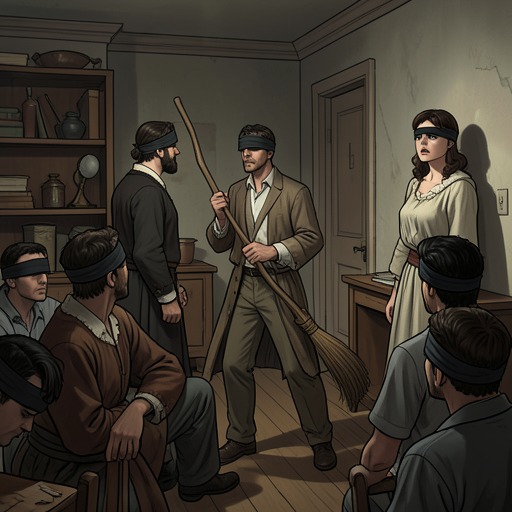
The attack became the reason the community adopted self-blinding as its absolute protection. Rick says residents used whatever they could find, including forks, kitchen knives, and their fingers. After a year, improved fortifications allowed them to abandon that practice, and Rick reports that the settlement had suffered no security lapses since. His explanation distinguishes an earlier phase of survival, when direct exposure was treated as intolerable, from a later system that depended on collective defenses.
Animals as Companions and Threats
The peril is not confined to people. When Malorie first arrives at the house, Victor, Jules’s six-year-old border collie, approaches her and waits to be petted. The ordinary welcome establishes the dog as a companion within the household rather than an abstract alarm device. That dependable relationship makes the later change in his behavior particularly devastating: Malorie recognizes his unfamiliar, tortured growl as something unlike any sound she has heard from a dog, and the post holding him begins to splinter. She thinks of Jules’s love for Victor and understands the dog as her last living link to the housemates.
The contrast between Victor’s earlier gentleness and later violent behavior undercuts the hope that familiarity can guarantee safety. The creature-related danger alters the meaning of a trusted animal without changing the human attachment to it. Malorie’s apology to Victor reflects both her distress at bringing him into danger and the collapse of her expectation that he could remain a stable companion.
The birds offer another sign that animal behavior has become perilous. Malorie feels what she first takes to be rain, then discovers a small dead bird in her hand. She infers that birds above her are attacking and killing one another. The discovery is not a direct view of the creatures; it is knowledge assembled through touch and sound under the rule that she must not look. The episode widens the crisis from a threat to individual animals to disorder among animals themselves.
Precautions and the Limits of Control
Because the creatures cannot safely be looked at, household security is organized around restricted sight, protected routes, and contingency plans. When Jules points out that the cellar door is old and delicate, he judges the attic door’s bolt much stronger and identifies the attic as the place to secure themselves if a creature gets into the house. The comparison makes architecture part of the response to madness: a locked refuge is valuable because exposure can turn an intrusion into a catastrophe.
The well routine likewise makes safety a practiced procedure rather than a matter of confidence. Felix walks blindfolded along a path outlined with pieces of old picture frames, with a rope tied around his waist and secured outside the back door. He carries the wooden bucket because it fits the well’s iron hooks, while Cheryl waits inside the closed back door as a safety net. Felix calls the task like the game Operation, but its playful comparison sits beside precise precautions: the rope, path markers, bucket, and watcher all acknowledge the risk of a mistake. Later, touching the well’s cobblestone rim, he wonders whether someone could fit inside before deciding to raise the bucket and return. The scene shows how uncertainty itself becomes part of ordinary work.
Tom’s proposed expedition plan assumes that animals may also become unsafe. He has been working on helmets to protect the blindfolds, proposes carrying butcher knives, and says dogs could lead the group, but warns that a dog that goes mad must be released; if it attacks, the people must defend themselves. The plan makes the dogs’ usefulness conditional. They may guide people who cannot see, yet their guidance cannot be trusted without a response to the possibility that they will change.
A Danger Carried Beyond the House
On the river, the threat continues to shape Malorie’s understanding of each new crisis. As she rows, she recalls the wolf striking, the unblindfolded man in the boat going mad, and the birds turning on one another, alongside the creature’s interference with her blindfold. These events accumulate rather than resolve into a single identifiable cause. The cloth remains her protection, but the danger surrounding it is no longer limited to what might happen if she looks: animals and people have already become unpredictable while she remains blindfolded.
Rick’s directions offer a route, not a guarantee. He tells Malorie that the river lies behind the house, about eighty yards from the well, and that the journey to the destination he recommends will be at least twenty miles. He also warns that the river splits. His instructions frame escape as a hazardous undertaking undertaken despite the threat, not as a way to restore dependable control over the world.
Narrative Significance
Across the household, the well, the birds, the dog, and the river, creature-induced madness is known by its effects rather than by a clear account of what the creatures are or how exposure works. The characters cannot safely investigate by looking. They instead infer danger from altered behavior, sounds, physical traces, and remembered losses, then build routines around what they cannot confirm.
That uncertainty makes protective practices necessary but incomplete. Blindfolds and fortified rooms limit exposure; ropes, markers, watchers, and weapons address risks that remain even when sight is denied. Victor’s change and the dead bird sharpen the same unsettling point: under the creatures’ influence, neither human judgment nor familiar animal behavior can be assumed to remain stable. The resulting madness is therefore both a bodily danger and a social one, disrupting the trust on which companionship, work, and collective survival depend.